
THE AUTHOR:

The ticket resale market is becoming more digital, mobile-first, and technologically advanced. So, what are the requirements to build a ticket marketplace platform for the present-day market? This article presents a guide to ticket marketplace platform development, focusing on the architecture, integrations, dynamic pricing, mobile ticket delivery, fraud protection, and resilient, high-load marketplace infrastructure.
How to build a ticket marketplace platform in 2026 and beyond: key market and user behavior trends
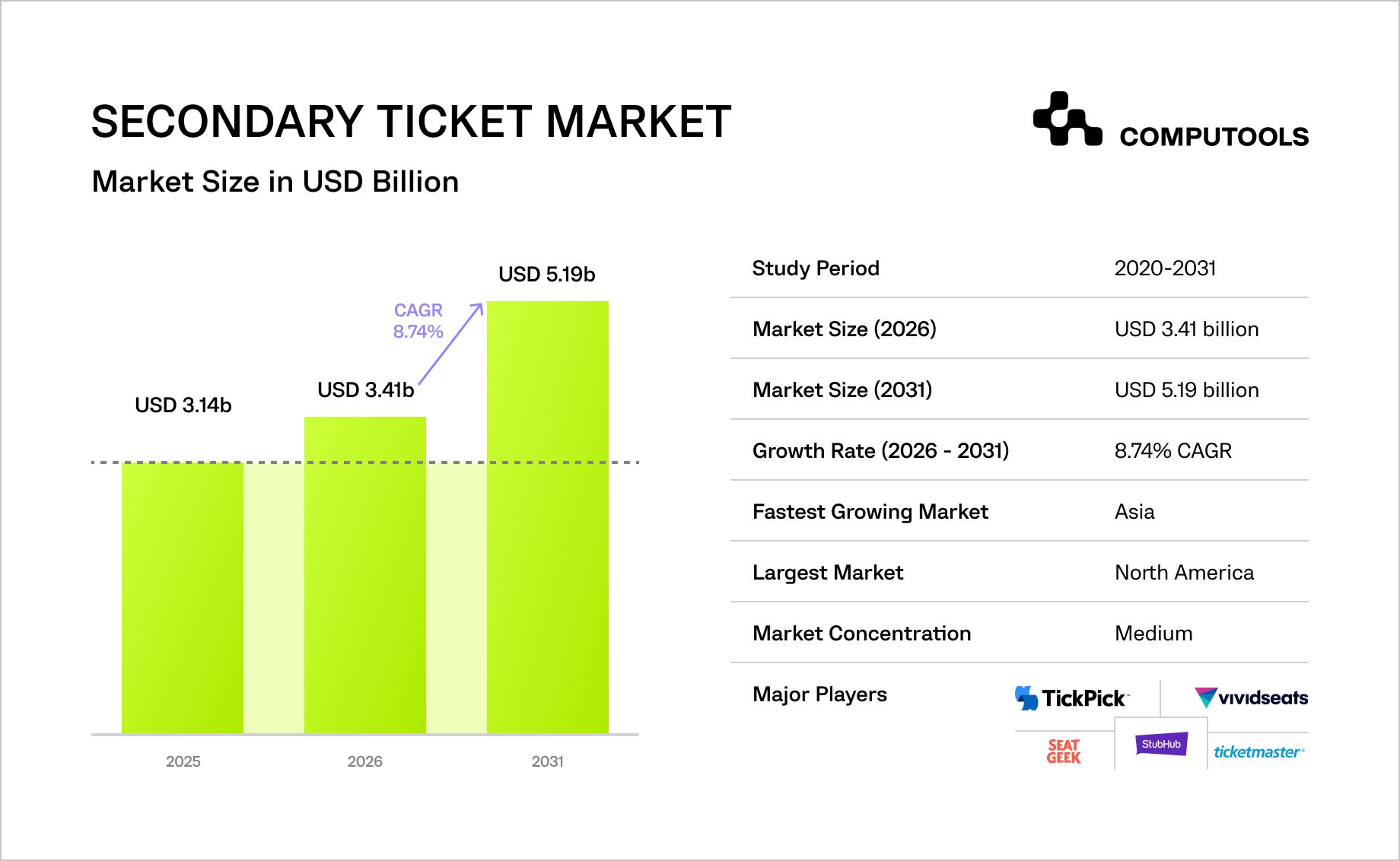
Mordor Intelligence estimates its worth to be USD 3.41 billion in 2026, and predicts its growth to USD 5.19 billion by 2031. 85.3% of secondary ticket market sales currently take place online, and 67.4% of these transactions occur via mobile devices. Clearly, a robust solution needs to support fast mobile flows, have accurate and real-time inventory, and provide cybersecurity for digital transfer from day one.
Live events continue to create strong demand for ticket marketplaces. According to the Live Nation report, Ticketmaster distributed over 637 million tickets in 2024 alone, serving over 11,500 clients in arenas, stadiums, festivals, sports, and other theaters and various venues. In 2025, the company also reported a growth in the concert ticketing and continued investment in marketplace capabilities, fraud reduction, AI-enabled features, and fan experience improvements.
Changes also appear in the behavior of customers. Buyers now compare prices across platforms, buy tickets closer to the times of the events, and expect instant delivery of tickets to their mobile wallets. For younger buyers, event recommendations are made more seamlessly by social media. Eventbrite’s TRNDS 2025 data shows that Instagram and TikTok are the most influential platforms for Gen Z ticket discovery.
Additionally, the use of flexible payment methods for events also plays a huge role. 51% of consumers are more likely to attend an event if they can pay in installments, and 56% would use BNPL for tickets over $100.
For ticket resale marketplace software, these trends dictate certain key product and system design elements. The platform must support real-time listing updates, dynamic resale pricing, mobile-first checkout, fraud detection, seller verification, secure payouts, and reliable ticket transfer. If listings expire, price adjustments happen late, and tickets cannot be verified quickly, the marketplace will quickly lose its appeal.
Providing resale features makes a marketplace product more complex than a standard ticketing system. The product has to manage buyers, resellers, payments, verification, and transfers in one controlled flow.

Multitrading case: building a high-concurrency ticket marketplace platform
Multitrading is a useful example for a ticket booking marketplace development because it reflects the same fundamental problem: selling tickets for a concert or large event while multiple users are accessing the service.
The platform needs to offer more than simply a ticket catalog. Users should be able to search events, select tickets, make purchases, and receive booking information without delay.
Project Challenge
The challenge was ensuring bookings were made in a consistent manner without compromising the information for events, tickets, or transactions.
Technical Approach
Computools re-engineered the platform with a focus on request processing, data handling, and system stability.
The solution included:
- multi-threaded backend logic to process many booking requests in parallel;
- optimized database queries to reduce response time during periods of high demand;
- structured data storage for events, ticket availability, transactions, and API-connected information;
- real-time synchronization to keep ticket status accurate across the platform;
- API integrations to support data exchange between internal and external systems.
This approach helped separate browsing from transaction-heavy operations. Users could continue viewing events, while booking actions were handled with stricter consistency rules.
Results and Relevance for Resale Marketplaces
The re-engineering improved platform performance and made the booking flow more stable under heavy usage. It also reduced delays in ticket selection and checkout, which directly affects conversion and user satisfaction.
For a ticket marketplace platform, the same principles apply:
- listings must update quickly;
- reservations must be protected from conflicts;
- payments and transfers must follow clear status logic;
- the platform must stay responsive when demand rises.

Launch your ticket marketplace platform in 1–3 months, not years, and start scaling reseller revenue with built-in inventory management, secure payments, automated payouts, and buyer trust from day one.
Why ticket marketplace platforms are operationally complex
A standard online ticket marketplace software usually sells primary inventory. The organizer controls the tickets, the prices are defined upfront, and the purchase flow is relatively direct: choose an event, select a ticket, pay, receive confirmation.
The operation of an event ticket resale platform is different. It connects the buyers to the third-party sellers of tickets, therefore, the system only has partial control over the inventory. Listings can appear, change, and disappear at any moment. Ticket prices are set based on different criteria, such as demand and proximity of the event, location of the ticketed seat, and strategy of the seller.
Because of this, the platform has a different set of requirements. The algorithms must verify that a ticket is still available for resale and is legitimate and transferable. The biggest challenge is keeping consistent synchronization demands throughout the ecosystem.
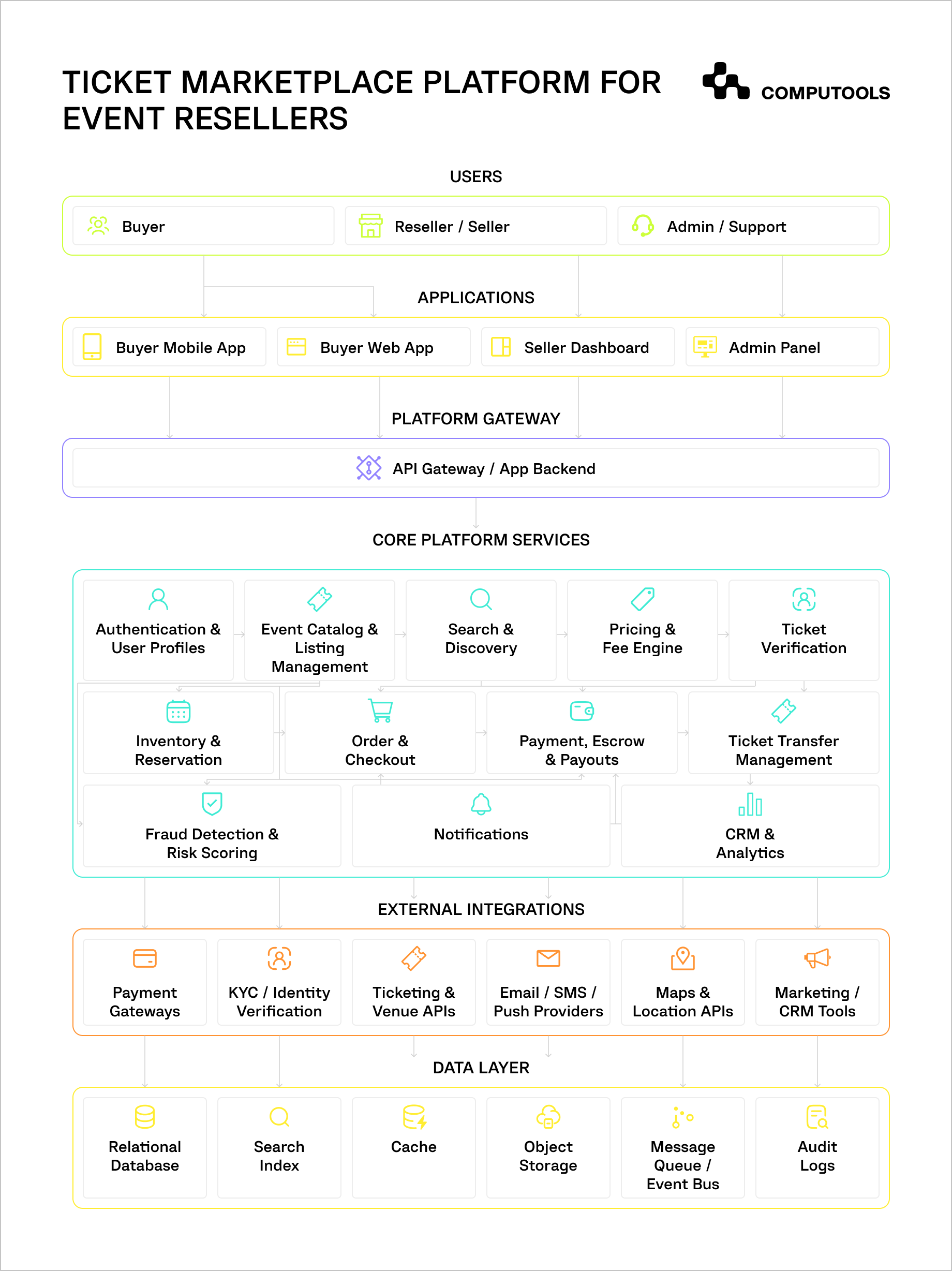
Current ticket marketplace software solutions use event-driven architectures, WebSocket updates, distributed caching, and real time streaming to maintain synchronization.
The resale model increases the risk. Listing ticket duplicates, fake tickets, and fraud disputes are all problems that need to be resolved through platform logic. This is why features that enable trust become product essentials.
A strong ticket marketplace needs to manage:
- The verification of sellers to mitigate fraudulent listings.
- The validation of tickets before or during the approval to list.
- A status of the current inventory in real time to ensure tickets are available.
- Pricing that dynamically adjusts to the current demand on the market.
- Delayed payment transfers until a ticket has been delivered to ensure a secure transaction.
- Refunds and disputes caused by invalid or failed transfers.
- Every ticketing listing needs to sustain accuracy, transferability, and verifiability.
Without these, buyers lose trust, and sellers will use competing vendors.
As users increasingly discover events through feeds, social platforms, and location-based recommendations, event marketplaces need stronger discovery logic than simple category filters.
Computools’ guide on how to build an urban event discovery platform, which explains how event search, personalization, and city-level engagement work together.
How to build a ticket marketplace platform for event resellers: step-by-step
Below is a practical guide on developing a secure and scalable ticket resale marketplace with real-time inventory synchronization, fraud prevention, dynamic pricing, and high-load transaction handling.
1. Define the Platform Model and Rules
To build a functional resale marketplace, you need to first determine your platform’s requirements. For a peer-to-peer solution, you’re going to have to build logic to onboard, verify, and process payouts, as well as handle disputes, all differently than how you’re going to accomplish the same for a broker marketplace or a hybrid reseller model.
At this stage, teams should also define the rules, each of which will later become a system workflow. Those are: who is permitted to sell tickets, how and when listings are approved, when sellers are paid, what the protocol is for a failed transfer, and the process for a ticket sale refund. These rules have ramifications for the database, ticket status, and user system from the start.
You will also want to define your primary data entities early on: events, venues, sellers, buyers, listings, ticket files, orders, transfers, payouts, disputes, and audit logs. A clean domain model will reduce the need to rework as more seller types, regions, and ticket formats are added to the system.
2. Design the Buyer and Reseller Experience Around Trust
The interface for the platform should be built around visible trust. Before taking any actions to purchase, a buyer should be able to see the event date, seat details, ticket type, transfer method, rating of the seller, the total cost, and the refund policy. Sellers should have the ability and a dashboard to upload tickets, adjust selling prices, monitor the status of their listings, and see when and how they will get paid.
From a technical perspective, every user interface state should be a true representation of the backend state. For example, tickets should not be shown as active on a seller’s dashboard if they are marked as “pending verification” on the backend. Also, if a ticket is marked as “reserved” on the backend, buyers should not see it as available on the platform.
This also eliminates support requests and prevents discrepancies between what the users see and the transaction state the platform will execute. For resale marketplaces, a great user experience is strongly dependent on effective state management.
3. Build the Event Catalog and Marketplace Feed
The catalog should allow for the organization of events, venues, performers, teams, dates, categories, and resale listings. Buyers should be able to search by event, city, performer, seat section, price range, and date.
From a technical standpoint, the catalog works best when event and listing data are separated. Event details are more or less structured and relatively static, while the listings change frequently. PostgreSQL is good for structured data. For the fast search and filtering capabilities, Elasticsearch or OpenSearch works best with transactional information.
For high-demand events, cache the event page and the listings in Redis or a CDN. The images and other media assets should be served from object storage and delivered through a CDN. Venue maps and performer images should also be delivered through a CDN.
4. Implement Ticket Listing, Verification, and Status Management
The ticket listing workflows must be efficient and controlled. To list a ticket, a reseller must upload the ticket, input the event and seating information, set the listing price, and submit the ticket to the system for verification. Until the ticket has been verified, buyers should be unable to see the listing.
A practical flow of ticket status may include: pending verification, active, reserved, sold, transfer in progress, transferred, failed, refunded, and blocked. This status model should be enforced not just in the interface, but also at the backend.
Verification may include barcode validation, proof-of-purchase upload, seller history, duplicate files, and ticketing or venue API integrations. Each listing update should also be stored in an audit log, which additionally helps the support team to investigate what happened in case of disputes.
5. Build Inventory and Reservation Logic
Resale inventory always has some degree of inaccuracy. A seller could list the same ticket elsewhere, remove it from the site, or leave the transfer incomplete after purchase. To help combat these issues, the event ticket marketplace solution should have sound reservation logic.
When a customer begins checkout, the listing should be temporarily reserved and marked as no longer active for purchase. This change should be done with an atomic operation to avoid conflicts.
Multitrading has valuable lessons to offer here. System reengineering was focused on designing booking systems that allowed for the simultaneous processing of multiple requests and reliable transaction guarantees. The same applies to resale marketplaces. Reservation and purchase logic should always operate on up-to-date data. Browsing, on the other hand, has a large tolerance for being outdated and can be cached.
6. Add Dynamic Pricing and Seller Tools
Resale prices vary throughout the day. Sellers need dynamic tools to keep pace. The priority features for the event ticket selling platform include manual price editing, minimum price limits, visibility of fees and estimated payouts, and pricing recommendations based on comparable listings and recent sales, quality of available seats, remaining inventory, and proximity to the event.
Pricing logic should always be separate from transaction logic. A pricing engine should be capable of analyzing marketplace data and making recommendations that do not interfere with system purchases or reservations. This limits exposure when the system is modified and improves scalability.
Transparency of pricing is important to buyers. The platform needs to include an estimated total price based on the ticket, service fees, taxes, and the cost of making the delivery or transfer. Unexplained fees drive potential buyers away and diminish trust.
7. Integrate Payments, Escrow, and Payouts
Handling payments in a marketplace differs from processing standard transactions. In a typical process, the buyer pays, and the seller immediately receives the payout. In online ticket exchange, it should only happen once the ticket is transferred to the buyer.
For ticket marketplace app development, choose a payment solution that accommodates marketplace transactions, delayed payouts, refund processing, and dispute resolution. The order must track the listing and the status of the transfer, payment, and payout. Doing so creates a clear link between the purchase, delivery, and payment to the seller.
You need idempotency in payment requests, too. Orders should not be created, nor should payouts be released, if a page refreshes, or if a payment provider sends the same webhook more than once. For payment accuracy, the system must implement webhook handling, reconciliation jobs, and payout release retries.
8. Add Real-Time Synchronization
The Multitrading project also shows why synchronization matters in ticket-related systems. When users are viewing the same event, selecting tickets, and completing purchases at the same time, every status change must be reflected quickly across the platform. In a resale marketplace, this applies to listing status, reservation status, payment status, and transfer status. Such changes must reflect immediately throughout the marketplace. If a ticket is reserved, sold, transferred, or removed, the change must appear to buyers and sellers without any page refresh.
WebSockets or pub/sub model can be used to push listing updates to active sessions. Tools such as Kafka, AWS SNS/SQS, or Google Pub/Sub can be used to implement event streaming for synchronizing status changes across services.
This layer is critical when combining multiple services: listings, orders, payments, transfers and notifications. Real-time changes of services result in reduced outdated listing and/or failed checkouts and decreased manual support.
9. Build Fraud Detection and Risk Controls
The architecture of a multi-vendor ticket marketplace should integrate fraud management. Resale platforms deal with fake listings, repeated purchases of the same ticket, stolen payment cards, account takeovers, and transfer issues.
Implement initial controls that are based on rules. For example, seller verification, duplicate barcode/QR detection, alerts for suspicious prices, device fingerprinting, age of account, new seller transaction limits, and manual reviews for the listings of higher value.
As you scale, add ML-based control mechanisms, risk scoring and fraud frameworks. For instance, if a seller is creating listings for expensive tickets and the account appears to be new, or a payment from the same device fails several times, the algorithms will consider such behavior suspicious.
10. Prepare for High-Demand Events
When the platform hosts major concerts, sporting and other sellout events, it must accommodate more users simultaneously compared to normal operation. It must support simultaneous browsing, price comparison, listing reservations, and payments.
To prevent system slowdown during these periods, separate read-heavy and write-critical operations. Event pages, listings, and feeds should be cached. Reservations, payments, and transfers should go through controlled services with strict consistency.
For events that are expected to sell out, a queuing system to limit simultaneous user entry to checkout should also be established. Before the launch of the platform, proper load balancing, autoscaling, database indexing, and rate limiting must be in place.
11. Test Marketplace-Specific Scenarios
The Multitrading case also reinforces the importance of testing under demanding conditions. Standard QA testing is not enough to prepare for resale. The marketplace system must be tested for specific situations that can result in revenue loss and client support issues.
Evaluate scenarios where two buyers attempt to buy the same ticket, where a listing is removed mid-checkout, where a payment is processed but the ticket fails to transfer, where a seller posts the same ticket multiple times, and where a payout fails to complete.
Simulate high-demand use cases with the k6 or JMeter load testing tools. Then implement monitoring for response times, reservations, payment failure, webhooks & transfer completion. This will help you find opportunities to strengthen the system against potential future scenarios.
12. Launch, Measure, and Improve
Initially releasing the core components of the marketplace loop is critical. This includes verified listings, buyer and seller payment and transfer mechanisms, and seller payouts. Once the transaction flow is stable, advanced AI pricing and resale recommendation systems and integrations may be implemented.
After releasing the marketplace loop to the public, you can begin to determine the health of the marketplace. This can be done by measuring the rate of listing approvals, the conversion rate of sales, the abandonment of checkouts, the average time of payment transfer and of seller payouts, and the rate of refunds, disputes, and fraud.
In order to build a thriving marketplace platform for event tickets, the work must be done to mitigate the risks, speed the processes of transferring tickets and payouts, and improve the accuracy and fairness of pricing.
For marketplaces focused on local events, concerts, festivals, or city experiences, discovery should also account for distance, venue location, and nearby activity.
Computools’ article on how to build a city navigation app with real-time location data explains how location-based systems support real-time movement, routing, and local discovery.
Why businesses choose Computools as a ticket marketplace development partner
Building a ticket marketplace for event resellers requires more than a standard e-commerce flow. The platform has to manage changing inventory, reseller verification, payment holding, ticket transfers, fraud checks, and high-demand booking periods without losing data consistency. Computools brings experience in these exact types of systems.
1. Experience with Transaction-Heavy Ticket Platforms
Multitrading shows Computools’ ability to work with high-concurrency ticketing logic, optimized backend processing, and structured event data. Tap App is another example. Its ordering logic required speed, accuracy, and smooth interaction between user actions and backend operations. In a ticket marketplace, the same principle applies: every delay in checkout or transfer results in a lost sale.
2. Real-Time Synchronization and Booking Accuracy
Computools designs platforms, such as Radesso Prime, where listing status, reservation logic, and payment processing work as one controlled flow. This helps reduce double-selling, failed checkouts, and manual support work.
3. Marketplace and Discovery Experience
Computools also has experience with platforms that rely on discovery and user engagement. SMARTCITY is a useful example of location-based discovery, real-time content, and user interaction at scale. For a ticket marketplace, a similar logic could be used to provide event feeds, nearby events, geo-based suggestions, and personalized listings.
4. Supported by End-to-End Development Services
With travel and hospitality software development services, Computools helps build platforms that connect tickets with broader travel and event experiences. This can include event + hotel bundles, venue partnerships, loyalty features, and integrations with booking systems or travel APIs.
Our experience in heritage tourism software development is beneficial for cultural events, tours, festivals, and museum programs. We can add location-based discovery, visitor routes, digital guides, and tourism content.
With software development services for HoReCa, Computools supports integrations with restaurants, hotels, and venues, helping platforms offer event + dinner packages, table reservations, group deals, and partner promotions.
Mobile and ticket marketplace website development under one roof. We apply our mobile app development services to design apps with fast checkout, saved carts, and push notifications that bring users back.
Our web development services ensure that the platform loads quickly, ranks in search, and stays stable during demand peaks. Both are connected to the same backend, so prices, availability, and bookings stay consistent everywhere.
With AI development services, Computools adds advanced functionality to improve marketplace performance. Pricing recommendations, buyer behavior analysis, fraud scoring, personalized event feeds, and seller alerts speed up buyers’ search and improve sellers’ pricing strategies.
5. What This Means for Your Ticket Marketplace
Partnering with Computools, clients get truly valuable and scalable solutions for all resale marketplace constraints: ticket unavailability, peak event demand, payment fraud, ticket transfer and selling delays. Our goal is to deliver a market-ready product that earns the trust of buyers, simplifies the process for the sellers, and ultimately allows your business to grow with minimal effort.
Businesses comparing development partners for travel, booking, and event-related platforms can also review Computools’ analysis of the top travel and hospitality software development companies.
Final thoughts
Creating an event resale marketplace extends beyond a simple ticket listing venue. There must be a controlled flow for ticket seller onboarding, ticket validation, sale reservation, payment holding, transfer confirmation, and payout. All parts must work together, because even one weak link can result in duplicate sales, failed transfers, disputes, and loss of buyer trust.
The development process should start with a clear marketplace model and robust status logic. It should then include verified listings, reliable dynamic pricing, payment and escrow integration, fraud prevention, real-time user queuing, as well as support for high-demand events. After the transaction flow is established, retention and growth can be achieved with AI-enabled recommendations that optimize seller pricing and marketplace personalization.
To build a ticket marketplace platform for returning users, make sure it can control ticket listings, trace every transaction, and guarantee every transfer during peak demand.
If you want to create a resale marketplace that is both seller- and buyer-friendly, reach out to us at Computools, and we will be happy to share a customized development plan that covers the marketplace’s structure and integrations. Contact our team at info@computools.com.
Computools
Software Solutions
Computools is an IT consulting and software development company that delivers innovative solutions to help businesses unlock tomorrow.