
THE AUTHOR:

Global assets under management are projected to grow from $139 trillion in 2024 to $200 trillion by 2030, while 89% of asset managers report pressure on profitability. Larger portfolios increase the volume of positions, market feeds, transactions, liquidity indicators, and regulatory records that firms must process without delaying investment decisions. Investment risk management software development companies build systems that consolidate these inputs, automate calculations, and give teams current visibility into exposure, concentration, liquidity, and changing market conditions.
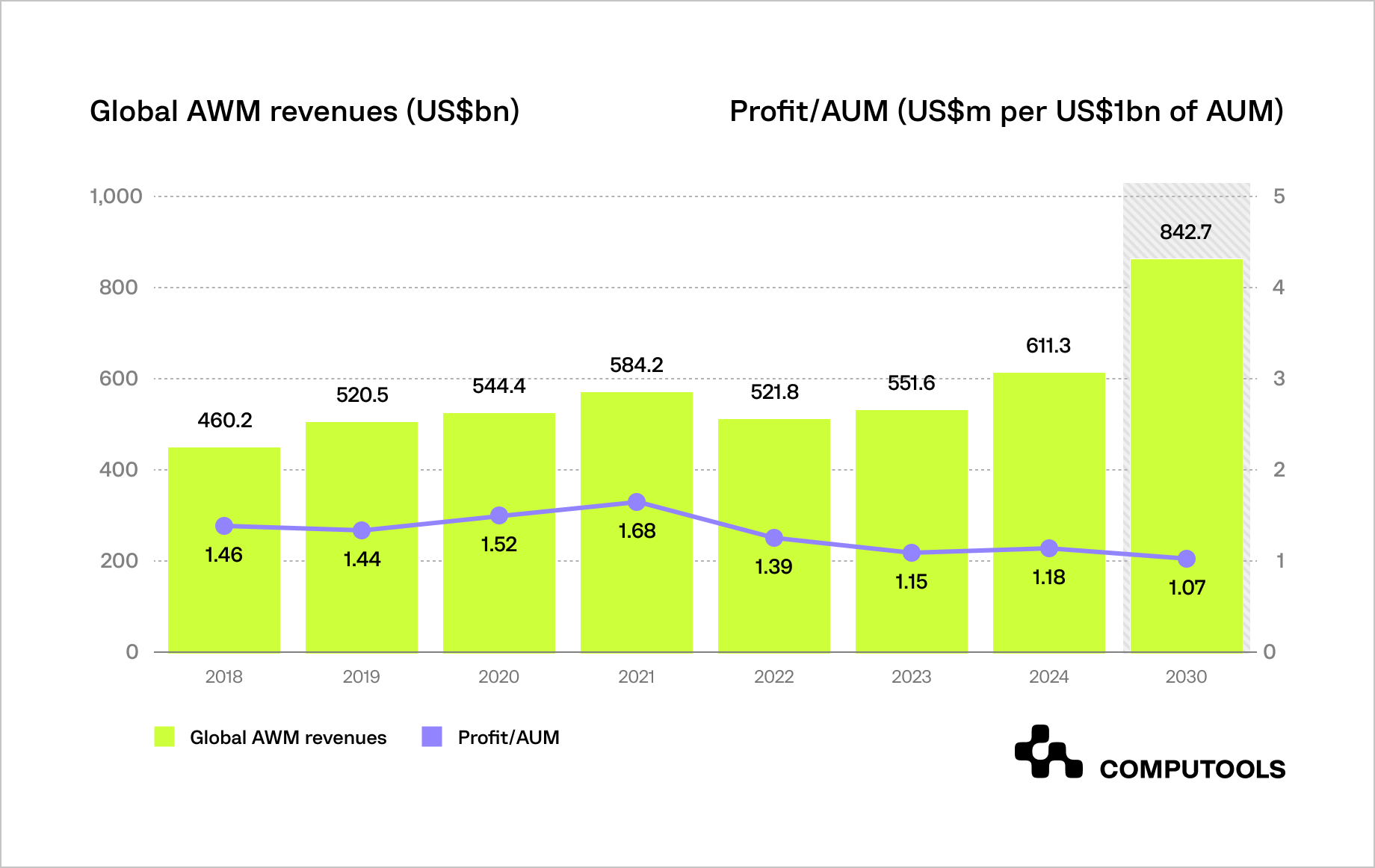
Global asset and wealth management revenues are forecast to reach $842.7 billion by 2030. Profit per $1 billion of AUM fell from $1.68 million in 2021 to $1.18 million in 2024 and is projected to decline further to $1.07 million by 2030. Growing asset volumes combined with lower unit profitability increase the need for automated risk calculations, consolidated data, and faster portfolio monitoring.
Top 15 investment risk management software development companies:
1. Computools
2. ELEKS
3. ScienceSoft
4. S-PRO
5. Relevant Software
6. Glorium Technologies
7. Codiant
8. DICEUS
9. inVerita
10. Tallium
11. Accedia
12. ScalaCode
13. Sapphire Software Solutions
14. DreamzTech
15. Future Processing
Liquidity risk creates an additional operational challenge. ESMA reported in 2026 that, across the analyzed sample of leveraged EU alternative investment funds, 44% of net asset value could be redeemed within one week without prior notice, while only 37% of portfolio assets could be liquidated over the same period. Portfolio risk management software helps firms detect such mismatches earlier by connecting holdings, redemption terms, cash positions, leverage, and market-liquidity data in one analytical environment.
Risk data often remains fragmented across portfolio systems, spreadsheets, broker platforms, market-data providers, and compliance tools. Manual reconciliation slows reporting, scenario analysis, and escalation while weakening auditability. A centralized platform standardizes calculations, preserves data lineage, and gives portfolio, risk, and compliance teams a consistent basis for decisions.
How the top investment risk management software development companies were selected
The ranking combines minimum business requirements with evidence of financial risk expertise, security maturity, data capabilities, and experience building systems for investment firms.
| Selection criterion | Assessment benchmark | Evidence reviewed |
| Market experience | 10+ years in business | Company history, official profiles, and public business records |
| Team capacity | 100+ employees | Official company data and GoodFirms profiles |
| Independent rating | 4.9–5.0 on GoodFirms | Current rating and verified client feedback |
| Security and quality | ISO 27001, ISO 9001, SOC 2, or comparable controls | Certification pages, security policies, and compliance documentation |
| Financial domain expertise | Confirmed work with asset managers, investment firms, wealth managers, banks, or fintech companies | Industry pages, service descriptions, client portfolios, and published delivery evidence |
| Risk analytics capabilities | Portfolio exposure, liquidity, concentration, volatility, Value at Risk (VaR), scenario modeling, or stress testing | Product capabilities, technical documentation, and public descriptions of financial risk systems |
| Data and integration expertise | Market-data feeds, broker and custodian APIs, portfolio systems, and internal financial platforms | Integration capabilities, architecture descriptions, and technology partnerships |
| Reporting and compliance | Risk dashboards, audit trails, regulatory reporting, and configurable controls | Compliance expertise, reporting functionality, and governance practices |
| Scalability and modernization | Ability to process growing data volumes and modernize legacy financial systems | Cloud capabilities, software modernization services, performance engineering, and delivery scale |
| Operational relevance | Clear impact on monitoring speed, calculation accuracy, reporting, manual workload, or risk visibility | Measurable outcomes where available and documented operational improvements |
These criteria helped distinguish general fintech vendors from firms with the scale, security maturity, and domain expertise required to build stress testing software, exposure-monitoring tools, and auditable risk platforms. The following 15 companies showed the strongest overall fit for complex investment risk projects.
Top 15 investment risk management software development firms
1. Computools
Computools at a glance
- 13+ years in business
- 250+ experts
- 400+ projects delivered
- 50+ financial software projects
- 10+ investment software projects
- 5.0 GoodFirms rating
- up to 45% faster portfolio and trade management
- up to 60% lower operational costs
- ISO 9001 and ISO 27001; GDPR compliance
- Microsoft and AWS Partner
Computools leads this list because it combines proven investment-sector delivery with responsibility for product strategy, architecture, risk logic, engineering, launch, and post-release scaling. Its investment software development services help asset managers, investment firms, and fintech companies replace fragmented tools with platforms that support portfolio risk analysis, trading operations, compliance workflows, investor access, and auditable decision-making.
Computools applies its data engineering expertise to design governed data layers that connect market feeds, holdings, transactions, client records, pricing data, historical datasets, and third-party platforms. Validation, normalization, reconciliation, and audit-ready data flows give analysts a reliable basis for calculating exposure, investment income, portfolio concentration, liquidity, and performance. Real-time and scheduled processing can be combined within the same architecture, allowing firms to support active trading workflows alongside periodic portfolio and regulatory reporting.
The company’s work for FDA Operator demonstrates this experience in an investment risk use case. Computools developed a scalable platform for processing large financial datasets, calculating investment income and risk, analyzing historical market information, and supporting portfolio diversification. The system made complex financial information easier to evaluate and helped the client increase its customer base by 46% while contributing to significant profit growth.
For Cryptotrade, Computools applied its MVP development services to create an exchange product with direct cryptocurrency conversion, CopyTrader functionality, real-time order monitoring, and liquidity management across multiple exchanges. A simulated development environment reduced prototyping costs and supported rapid validation, helping the client complete the MVP and attract external investment.
Computools follows a phased implementation model in which data quality, calculation logic, integrations, security controls, performance, and user workflows are validated before wider rollout. This approach gives investment firms clearer control over scope, priorities, and budget while reducing the operational and technical risks associated with launching data-intensive financial platforms
2. ELEKS
ELEKS at a glance
- 35 years in business
- 2,000+ experts
- 5.0 GoodFirms rating
- ISO 9001:2015 and ISO/IEC 27001:2022
- SOC 2 Type II, CREST, and Cyber Essentials Plus
ELEKS develops investment risk management software solutions for hedge funds, asset managers, brokerages, stock exchanges, and financial institutions. Its capabilities cover real-time position tracking, P&L analysis, risk attribution, liquidity monitoring, regulatory reporting, portfolio controls, and integrations with market and historical data sources.
The company also builds tools for Monte Carlo simulations, scenario modeling, portfolio stress tests, and VaR calculations. These systems help investment teams quantify exposure, assess potential losses under changing market conditions, automate compliance checks, and maintain portfolio stability during periods of volatility.
3. ScienceSoft
ScienceSoft at a glance
- 37 years in business
- 750+ IT professionals
- 4,300+ projects delivered
- 5.0 GoodFirms rating
- Investment IT expertise since 2007
- ISO 9001, ISO/IEC 27001, and ISO/IEC 27701
ScienceSoft builds risk management systems for asset managers, hedge funds, mutual funds, ETF providers, brokerages, and other investment businesses. Its capabilities cover real-time exposure monitoring, portfolio valuation, liquidity controls, regulatory reporting, and the calculation of standard deviation, VaR/CVaR, maximum drawdown, Sharpe and Sortino ratios, VIX, and foreign-exchange exposure.
The company supports scenario analysis through configurable financial models, Monte Carlo simulations, hedging strategy assessment, what-if calculations, and automated portfolio stress tests. These tools help investment teams quantify potential losses, compare risk-adjusted outcomes, monitor changing market conditions, and maintain consistent risk controls across multiple portfolios and asset classes.
Computools’ guide to building an investment management platform with real-time market data examines a practical architecture for connecting market feeds, portfolio calculations, reporting, and risk controls.
4. S-PRO
S-PRO at a glance
- 12 years in business
- 200+ engineers
- 300+ projects delivered
- 4.9 GoodFirms rating
- ISO 27001 and ISO 27701
- Asset management and fintech expertise
S-PRO develops financial systems for asset managers, issuers, brokers, and wealth management providers. Its capabilities cover real-time portfolio tracking, risk monitoring, active rebalancing, order management, daily NAV calculations, configurable reporting, and integrations with market and financial data sources.
The company supports investment portfolio analytics through dashboards for monitoring holdings, performance, valuation, and changing exposure. Automated compliance checks, fee calculations, and audit trails help investment teams centralize portfolio data, reduce manual processing, and maintain traceable controls across investment operations.
5. Relevant Software
Relevant Software at a glance
- 13 years in business
- 100+ in-house experts
- 246 projects delivered
- 5.0 GoodFirms rating
- ISO 27001:2022 certified
- GDPR and fintech compliance expertise
Relevant Software builds financial products for banks, investment businesses, wealth management providers, and fintech companies. Its capabilities cover portfolio management, automated financial planning, real-time market insights, portfolio optimization, ML-based investment analytics, and integrations with financial data sources.
The company also develops AI-supported risk assessment, transaction monitoring, regulatory reporting, and compliance automation tools. These capabilities help financial teams consolidate portfolio and transaction data, monitor performance and emerging risk indicators, and reduce manual work across reporting and control processes.

Launch your investment risk management platform in 1–3 months, not years, and help your teams identify portfolio risks earlier, automate analysis, and make faster investment decisions without increasing operational overhead.
6. Glorium Technologies
Glorium Technologies at a glance
- 16 years in business
- 250+ professionals
- 150+ products delivered
- 4.9 GoodFirms rating
- ISO 9001 and ISO 27001
- SOC 2 and fintech compliance expertise
Glorium Technologies develops fintech products for financial institutions, investment businesses, wealth management providers, and digital finance startups. Its capabilities include portfolio tracking, predictive analytics, financial data processing, credit scoring, fraud detection, transaction monitoring, and integrations with external financial services.
The company’s investment risk management software developers build analytical tools that combine portfolio, transaction, and market information for ongoing monitoring and decision support. AI models, configurable dashboards, and automated data workflows help financial teams identify unusual activity, evaluate changing risk indicators, and reduce manual analysis across connected systems.
7. Codiant
Codiant at a glance
- 16+ years in business
- 550+ in-house engineers
- 1,500+ projects delivered
- 4.9 GoodFirms rating
- ISO 9001:2015
- Fintech, portfolio management, and regulatory compliance expertise
Codiant develops fintech platforms for investment tracking, portfolio management, financial planning, and automated reporting. Its capabilities include real-time market insights, portfolio performance monitoring, risk assessment, compliance checks, and analytical dashboards that consolidate financial and operational data.
The company also supports credit risk modeling through ML-based scoring, loan-risk analytics, transaction monitoring, and predictive models. These capabilities help financial teams standardize data inputs, automate selected assessments, and identify changes in borrower or portfolio risk across connected workflows.
For a closer look at the architecture behind configurable financial risk assessments, Computools’ guide to risk scoring engine development covers data inputs, decision rules, model outputs, reason codes, and audit trails.
8. DICEUS
DICEUS at a glance
- 15 years in business
- 250+ full-time specialists
- 150+ projects delivered
- 5.0 GoodFirms rating
- ISO 9001:2015 certified
- Fintech, banking, investment, and wealth management expertise
DICEUS develops financial systems for banks, investment firms, wealth management providers, and fintech businesses. Its capabilities cover portfolio risk assessment, real-time financial data analysis, predictive modeling, compliance workflows, business intelligence, and integrations with existing banking and investment infrastructure.
The company supports market risk management through tools that monitor portfolio performance, volatility, market movements, and changing exposure. Its AI, ML, cloud development, and analytics expertise helps financial teams improve risk visibility, automate selected controls, and make faster portfolio decisions using current and historical data.
9. inVerita
inVerita at a glance
- 11 years in business
- 150+ engineers
- 4.9 GoodFirms rating
- ISO/IEC 27001 certified
- Fintech, investment management, and data analytics expertise
inVerita develops fintech risk management software for investment funds, private wealth businesses, trading companies, and financial institutions. Its capabilities include investment analytics, portfolio and transaction reporting, trade execution workflows, real-time financial data access, risk monitoring, and compliance-focused business intelligence.
The company also builds data pipelines and analytical environments that combine financial transactions, customer activity, and third-party risk indicators. Its trading expertise includes REST, WebSocket, and FIX integrations that standardize data from multiple cryptocurrency exchanges, helping financial teams maintain consistent information across execution and monitoring systems.
10. Tallium
Tallium at a glance
- 14 years in business
- 120+ professionals
- 5.0 GoodFirms rating
- Fintech, investment, and wealth management expertise
- Security and regulatory compliance experience
Tallium builds portfolio risk management software for investment firms, trading providers, savings platforms, and fintech companies. Its capabilities cover portfolio management, robo-advisory workflows, real-time trading platforms, alternative investment products, and dashboards that consolidate financial and risk data for faster monitoring.
The company also develops AI-driven risk assessment engines, automated investor profiling, compliance workflows, and integrations with financial services and external data sources. These capabilities help firms standardize risk evaluation, improve portfolio visibility, and reduce manual work across investment and advisory operations.
11. Accedia
Accedia at a glance
- 13+ years in business
- 250+ engineers
- 4.9 GoodFirms rating
- ISO 9001:2015 and ISO/IEC 27001
- DORA, PSD2/PSD3, GDPR, AML/KYC, SEC, and FINRA expertise
Accedia develops financial systems for wealth managers, banks, fintech businesses, and regulated financial institutions. Its capabilities cover portfolio tracking, real-time risk analytics, AI predictive models, automated reporting, and data platforms that consolidate transaction, customer, and exposure information.
The company also supports investment compliance through regulatory monitoring, traceable reporting, secure data controls, and integrations with legacy financial systems. These capabilities help teams detect changes in exposure, reduce manual checks, and maintain consistent controls across regulated investment operations.
12. ScalaCode
ScalaCode at a glance
- 14 years in business
- 250+ full-time engineers
- 500+ production systems delivered
- 5.0 GoodFirms rating
- ISO 9001:2015 certified
- Fintech, trading, and wealth management expertise
ScalaCode develops financial products for fintech companies, trading businesses, wealth management providers, and portfolio teams. Its capabilities include broker integrations through FIX and REST APIs, real-time market data, portfolio views, tax-aware reporting, predictive analytics, fraud-risk scoring, and compliance-ready audit trails.
The company supports portfolio risk analytics through financial data pipelines, monitoring dashboards, predictive models, and integrations that consolidate portfolio, transaction, and market information. These capabilities help teams track changes in exposure, identify unusual activity, and improve risk visibility across connected investment workflows.
13. Sapphire Software Solutions
Sapphire Software Solutions at a glance
- 23+ years in business
- 200+ IT professionals
- 1,500+ projects completed
- 4.9 GoodFirms rating
- Financial AI, trading, and banking analytics expertise
Sapphire Software Solutions builds AI investment risk management software for financial institutions, trading businesses, fintech companies, and investment platforms. Its capabilities cover predictive market analysis, real-time financial forecasting, automated risk assessment, fraud detection, intelligent asset allocation, and compliance monitoring.
The company also develops stock-trading tools with sentiment analysis, risk-scoring modules, portfolio optimization, automated trading, and secure financial data processing. These capabilities help investment teams monitor market signals, evaluate portfolio changes, and automate selected risk and compliance workflows.
14. DreamzTech
DreamzTech at a glance
- 13 years in business
- 450+ engineers
- 5.0 GoodFirms rating
- ISO 27001 and SOC 2 Type II
- PCI DSS, SOX, KYC/AML, and GDPR expertise
DreamzTech develops secure financial platforms for banks, fintech companies, lenders, payment providers, and wealth management firms. Its capabilities cover AI-based risk assessment, transaction monitoring, fraud detection, regulatory workflows, portfolio tracking, investment performance analysis, and integrations with banking and financial data services.
The company also builds risk reporting dashboards that consolidate portfolio performance, financial activity, compliance indicators, and predictive insights. These systems help investment teams monitor changes in exposure, detect unusual activity, improve reporting visibility, and reduce manual review across connected financial workflows.
15. Future Processing
Future Processing at a glance
- 26 years in business
- 750+ professionals
- 4.9 GoodFirms rating
- ISO 9001 and ISO 27001
- Finance, AI, data, and regulated-platform expertise
Future Processing develops data-intensive systems for banks, fintech companies, supply chain finance providers, and regulated financial platforms. Its capabilities include data pipelines, predictive models, automated decisioning, rules engines, transaction monitoring, compliance controls, and cloud modernization.
The company applies investment risk analytics to environments that require reliable data processing, traceable calculations, and consistent monitoring across connected systems. Its engineering experience supports financial organizations that need to assess exposure, improve risk decisions, process large transaction volumes, and reduce manual work across complex operational workflows.
The data controls behind reliable financial models are covered in Data Governance in Fintech Software Development, including lineage, accountability, data quality, and regulatory oversight.
Beyond vendor experience, investment firms should evaluate whether the proposed platform can support the data, modeling, monitoring, integration, and reporting requirements of daily risk operations.
What investment risk platforms should support
A modern risk platform needs a governed data foundation before analytical models can produce reliable outputs. Holdings, trades, prices, corporate actions, cash positions, benchmark data, and reference records should enter through controlled pipelines with validation, normalization, and reconciliation rules. The system should preserve source details, calculation timestamps, and transformation history so analysts can trace every reported result back to its underlying inputs. This data foundation reduces disputes between portfolio, risk, operations, and compliance teams and shortens the time required to investigate anomalies.
Financial risk management software should also separate model configuration from application code. Risk teams need controlled access to assumptions, confidence levels, holding periods, thresholds, and asset-specific methodologies without waiting for a full software release. Versioning, approval workflows, benchmark comparisons, historical backtesting, and documented change records allow firms to validate new calculations before production use. These controls are especially important when the same platform supports portfolios with different mandates, currencies, liquidity profiles, and regulatory obligations.
Monitoring capabilities should help users move from an aggregate portfolio result to the positions and factors driving it. Dashboards can organize exposure by asset class, issuer, geography, currency, counterparty, sector, strategy, or liquidity bucket, while alerts identify threshold breaches and material changes. Intraday processing is useful for trading environments, while scheduled batch calculations may be sufficient for less active portfolios. The architecture should support both patterns and allocate additional computing resources to intensive simulations without delaying routine reporting.
Integration and reporting determine whether the platform becomes part of daily investment operations. APIs and secure data exchanges should connect portfolio management systems, order management tools, custodians, brokers, market-data vendors, accounting platforms, and compliance applications. Role-based dashboards, scheduled reports, documented calculation methods, and export controls give investment, risk, audit, and regulatory teams access to consistent information. Firms should also assess recovery procedures, access management, monitoring, and scalability, because analytical accuracy has limited value when the system cannot process a volatile trading day or restore critical workflows after an operational incident.
Why investment firms choose Computools
Computools combines investment-domain delivery with the technical capabilities required to build and scale investment products. Its investment software development services are structured around validated workflows, governed data, and phased implementation, giving investment firms a clearer route from concept to production with lower execution risk.
- Coordinated delivery across regulated workflows. Computools brings product strategy, UX, architecture, data engineering, compliance, quality assurance, cloud implementation, and ongoing support into one delivery model. This reduces handoff risks and keeps calculation logic, financial integrations, reporting, and user workflows aligned as the platform expands.
- Integrated lending and financial ecosystems. Through its financial software development services, Computools delivered Invest Latam within four months, connecting KYC, identity verification, creditworthiness checks, secure payment mechanisms, and investor-matching logic. The platform supported more than 1,000 business lending transactions over five years, providing small businesses with access to capital and investors with a structured direct-lending channel.
- Trading platforms and mobile market access. For Synergy FX, Computools applied its web development expertise to redesign regional pages, account-opening workflows, and customer journeys for a global forex broker, contributing to higher online sales and stronger digital performance. Its mobile app development services also helped KenCharts extend its stock-monitoring product to Android with real-time equity prices, technical indicators, configurable charts, filters, and tracked asset lists, resulting in 54% higher user throughput and a 67% productivity increase.
- AI-ready analytics with controlled implementation. Computools’ AI development services support investment forecasting, portfolio modeling, risk assessment, pattern detection, and automated analytical workflows. The team validates data quality, calculation logic, integrations, security controls, and system performance incrementally, giving investment firms measurable checkpoints before wider deployment.
Conclusion
The strongest development partner should be able to connect governed financial data, validated risk models, scalable calculation services, and auditable reporting within the firm’s existing investment environment. The final choice should reflect the organization’s asset classes, regulatory scope, integration complexity, calculation frequency, and model-governance requirements.
Computools
Software Solutions
Computools is an IT consulting and software development company that delivers innovative solutions to help businesses unlock tomorrow.